Step 2 of 8Explainer7 min
Three ways to make rules
There are three main ways to set rules for AI. Each has a different enforcer, and each fails in its own way. Everything here is as of October 2026, and it will change.
Binding law. The EU AI Act is the broadest AI law so far. It uses a
Government policy. The US has no broad federal AI law. Presidents have set direction through executive orders instead. A 2023 order on AI safety was revoked in January 2025. A December 2025 order told federal agencies to challenge state AI laws the administration saw as too burdensome. In January 2026, the Justice Department set up a task force to do that in court.
Voluntary commitments. In July 2023, seven AI companies promised the White House they would safety-test models and help people spot AI-made content. No law required it and no one enforces it. That is a
| Approach | Who enforces it | Strength | Weakness |
|---|---|---|---|
| Binding law | Regulators, with fines | Applies to every company it covers | Slow to write and slow to update |
| Government policy | Federal agencies | Can change within weeks | Can be reversed just as quickly |
| Voluntary commitment | No one | Companies can act before any law exists | No penalty for breaking it |
Think about it
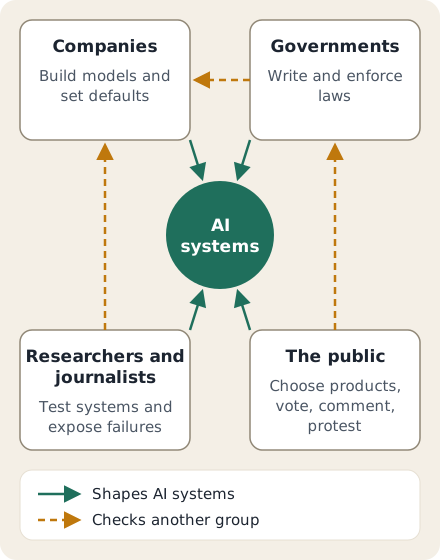
Which group on the map can act the quickest? Which one can you vote out?