Step 2 of 8Explainer7 min
How a chatbot is made, and why it guesses
Most AI text tools run on a
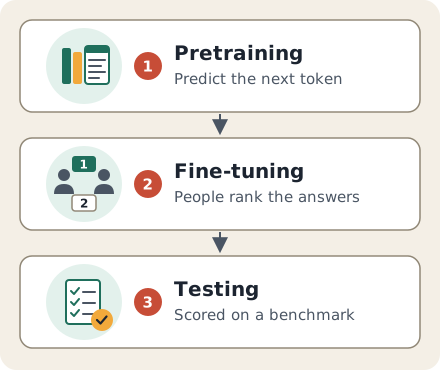
Stage 1: pretraining. The model reads an enormous amount of text and practices one task over and over. It predicts the next small chunk of text, called a token. Nobody tells it what is true. It learns what usually comes next.
Stage 2: fine-tuning. People write example answers and rank the model’s replies from best to worst. The model is then trained to favor the replies people rank highest. In a 2022 OpenAI study, people preferred a fine-tuned model’s answers to those of a model 100 times its size. Rankings have a side effect, too: agreeable answers tend to win. Module 5 returns to this.
Stage 3: testing. Companies score the model on a
A model can state false things with total confidence. This is called a
Think of a multiple-choice test with no penalty for wrong answers. A student who guesses on every question will usually beat one who leaves blanks. The paper says most AI benchmarks are graded the same way. “I don’t know” earns zero, while a confident guess sometimes earns full marks. So training and testing both reward guessing.
Fact
Fluent is not the same as correct. By October 2026, a public database listed 2,184 court cases where filings contained AI-invented citations.
The paper’s proposed fix is partly social: score the major tests so honest uncertainty stops losing points. That is a human choice, not a law of nature.