Step 2 of 8Explainer7 min
Four design questions
Before writing any code, answer four questions:
- Who is this for? Name real users. “Everyone” is not an answer.
- Who could it harm? Include people who never use it.
- What data does it need? Collect only what the job requires.
- What happens when it is wrong? Who notices, and how do they fix it?
Question 2 is where a stakeholder map helps. Start with the people in the middle and work outward.
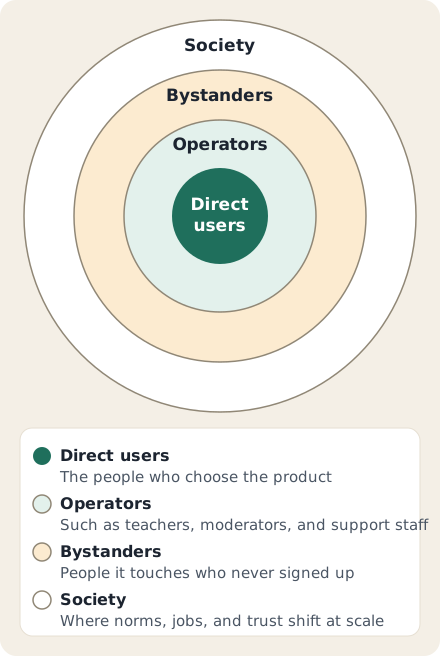
Here is a worked example. The product is an AI tool that summarizes school board meetings for students who can’t attend.
- Who is it for? High school students who want to follow board decisions about their school.
- Who could it harm? Board members, if a summary misquotes them. Students, if they act on a wrong summary. Parents and teachers, the bystanders who never chose the tool.
- What data does it need? Only the public meeting recordings. No student data at all.
- What happens when it is wrong? Each summary links to the exact moment in the recording. There is a “report an error” button, and a person reviews summaries before posting.
Notice how the answers to question 4 turn into features. That is the point. Design questions become design decisions.