Step 2 of 6Explainer7 min
Where does bias come from?
Bias can get into an AI tool at more than one point. Here are three big ones.
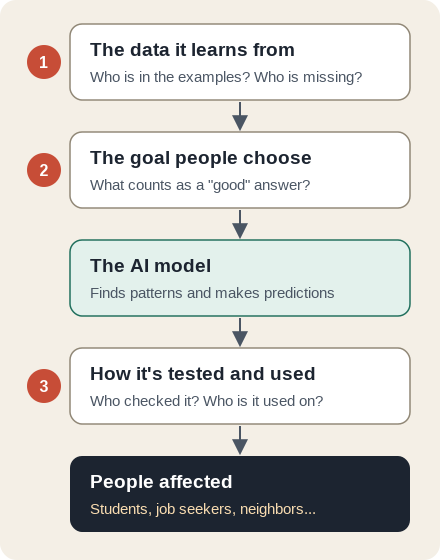
1. The data it learns from
A tool learns from its
2. The goal people choose
Someone decides what the tool should do and what counts as a good answer. “Find applicants like the people we hired before” sounds reasonable. But if past hiring was unfair, that goal asks the tool to copy the unfairness. In 2018, the news agency Reuters reported that Amazon had scrapped an experimental résumé-screening tool after its team found the tool favored men.1
3. How it’s tested and used
Even a well-built tool can cause harm if it’s only tested on some kinds of people, or used for a job it wasn’t built for.
Some police departments have used tools that predict where crime might happen, based on past arrest records. Researchers have shown how this can go wrong: the tool sends more officers to the same neighborhoods, which leads to more arrests there, which the tool then treats as proof it was right.2 That kind of cycle is called a
Try it
Where did the bias come in? Put each card in a bucket.
Card 1 of 6
A face recognition tool learned mostly from photos of adults, so it often gets kids' faces wrong.
Put it in(or drag it)
The data it learned from 0 cards
Nothing here yet.
Choices people made 0 cards
Nothing here yet.
Tip
When you hear about a new AI tool, ask three questions: What did it learn from? Who decided what it should do? Who was it tested on?
Sources
-
Jeffrey Dastin, “Amazon scraps secret AI recruiting tool that showed bias against women,” Reuters, October 10, 2018, reuters.com. ↩
-
Danielle Ensign, Sorelle A. Friedler, Scott Neville, Carlos Scheidegger, and Suresh Venkatasubramanian, “Runaway Feedback Loops in Predictive Policing,” Conference on Fairness, Accountability and Transparency, 2018, arxiv.org/abs/1706.09847. ↩